Sunday, August 4, 2013

Recession and Missionary Service

The Church of Jesus Christ of Latter-day Saints experienced an 18.0% decline in the number of missionaries set apart over the two year period beginning in 2003.  Many observers attributed the decline to a policy change announced by Apostle M. Russell Ballard in the October 2002 General Conference that “raised the bar” or worthiness standards for missionary service (see Peggy Fletcher Stack. “Unintended consequence of church's 'raising the bar'” for example).  I doubted that increasing worthiness standards would dramatic reduce missionary numbers and began considering alternatives.  In addition to policy governing missionary service I thought war, recession and demographics would influence young men and women considering missionary service.  This post updates past work by adding recessions to the mix of war and Church missionary policy as determinants of missionary numbers.

My time frame begins in 1929 and ends in 2011.  In a series of four posts: A Second Negative Effect of the Vietnam War on Missionary Work, Many Were Drafted but Few Were Called: Missionary , The Impact of WWII and the Korean War on Missionary Work, and War and the Missionary Force, I examined some impacts of war on the missionary work of the Church of Jesus Christ of Latter-day Saints.  Simply stated, war reduces the number of missionaries set apart. 

To evaluate the simultaneous impact of policy, war and recession, I present data in two graphs that split the period.  Both graphs show the number of missionaries set apart each year as a line that is divided into a blue segment representing periods of peace and a red segment representing periods of war.  Also in the graph are gray rectangles representing periods of recession.  Data on recessions was provided by The National Bureau of Economic Research’s Business Cycle Dating Committee.  Finally, the graph contains black vertical lines on the dates that the Church made major policy announcements concerning missionary service.  A summary of important announcements and the dates they were make is provided below the main body of the post.  

Thursday, July 4, 2013

Missionary Assignments by Language and Region

13 June Language

More missionaries are serving than at any time!  The post updates a previous post, “May Update on Mission Assignments by Language.”  I use data collected from YouTube videos if missionaries reading their calls to show where missionaries are serving and the languages they speak.  I collected 814 videos in which the missionary reads both the mission and the language, 471 calls are to men and 343 to women.  As an important note, a number of observations, 156, did not name the language to be spoken; given the country that these missionaries will be serving, most of those missionaries will be speaking English.  The Church of Jesus Christ of Latter-day Saints teaches missionaries approximately 50 languages; my data set includes 35 languages. 

Wednesday, July 3, 2013

June 2013 YouTube Missionary Calls

2013 June YouTube Callings

In “Temporary MTC opens, LDS Church projects 47 percent increase in missionaries,” Church officials reported that the number of missionaries serving would reach 85,000, a 47% increase from the prior year due in large part to the lowering of the age that missionaries can begin service.  As pictured in the graph, “Mission Calls Posted to YouTube,” applications surged.  In June, missionary applications may have peaked.  The graph separates the calls to young women and men from November 2011 to June  2013.  In June, calls to men fell from 125 in May to 74 and calls to women fell from 91 to 61.  

The surge peaking does not imply that the number of missionaries serving has peaked.  As long as missionary calls in the coming months exceed the calls issued in the previous year’s corresponding months, missionaries serving will continue to rise.  As a reminder the YouTube data has a weakness: it over reports the increase in applications after President Monson’s announcement.  The next two graphs show month to month comparisons of the number of calls posted to YouTube for the past two years.  The lower line representing calls before the announcement should be higher.

13 June Sisters

13 June Elders

The number of calls issued to sisters remains significantly above the number of calls issued the previous year and should remain higher than the previous year at least until November, the first month that calls could be issued after President Monson’s announcement lowering age requirements.  Likewise, the number of calls issued to Elders remains at high levels.  Again, November will be an interesting month. 

13 June Callings  by Region

The graph, "Three Month Moving Average of the Location of Mission Assignments," shows a three month moving average of the percentage of calls read on YouTube to seven geographic regions. They are the regions reported by the Church on the “Facts and Statistics” page of the “Newsroom” with one exception. I divided the North America region into two groups: the United States and the rest of North American (North American not US). As demonstrated in the June graph, the influx of applications has not precipitated major changes in the percentage of missionaries called to each region although calls to the United States have risen since January and calls to Europe have declined.  A similar trend in calls by region occurred the prior year. 

Tuesday, June 25, 2013

Missionary Work Via the Internet

On Sunday, June 23rd at the Seminar for New Mission Presidents the church announced that missionaries would be able to proselytize via the Internet and give guided tours of meeting houses.  Deseret News explored the experiences of missionaries who tested these new programs in “Online missionaries? LDS meetinghouse tours? Been there, done that.”  The experiences were positive.  While the cynic in me concludes that of course they would be positive, that same cynicism leads me to conclude that the Church, after testing these programs, has concluded that the benefits easily outweigh the costs.  Not only did I enjoy the article, but I enjoyed the comments as well and recommend them to anyone interested in the topic.  I will focus my comments on use of electronic communications.

The use of Facebook and blogs will change the geographic assignments of missionaries to areas at least a little as noted by two missionaries from the Montana Billings Mission.

…Eric Whitlock of Gilbert, Ariz., who served as a full-time missionary in the church's Montana Billings Mission from 2010-12…said…he felt impressed to reconnect online with a friend from home who, it turned out, was going through a spiritual crisis. "As soon as I was able to get on Facebook, I was able to talk to him and help him stay on track, and today he's serving as a missionary himself,"

Another Montana missionary reconnected with a family friend who was living in England. He started teaching her the gospel online, eventually turning her over to missionaries in England. She joined the church and is now serving as a missionary in Estonia.

Missionaries have always communicated with friends and family via mail, but Facebook is much faster.  In a comment, boyztomany noted the positive impact that Facebook had in an area in wh8ich his son served

My son was in the Canada Vancouver Mission (2010-2012) They were a test mission. He set up a facebook account for his area and used it to contact members/non-members. They used it to advertize young single adult activities that non-members/inactive members began coming to more frequently.

In another comment, Red enthusiastically endorsed the new program stating

There are missions out there that average 1/2 a baptism in 2 years because "knocking" is so lame and ineffective.

People are too paranoid to let someone in their house. They also are too concerned what their neighbors will think of them if they let the Mormons in.

Networking will be 1,000 times more effective.

If Red meant they will be 1,000 times more effective baptizing, he exaggerates but perhaps not if you include satisfaction in service.  If baptisms increase just ten percent, given the increase in missionaries to 85,000, next year the church could experience 432,000 convert baptisms.  A twenty percent improvement leads to 470,000 baptisms. 

The new tools may have a big impact on retention.  It is easy to imagine a new member friending three or four people in the ward and becoming more connected to their families, interests and church activities.  Socialization of new members has always been a challenge.  It has become easier. 

Friday, June 21, 2013

Demographics

Our children are our future and the number of children is dependent on the birthrate.  Is there an optimal population and have we exceeded it?  Two articles present very different views of the future of our country and the world based on birth rate.  They both address the Malthusian conclusion that mankind faces an economically bleak future because population growth will outpace economic development.  Hunger, disease and war are positive checks that limit population growth to the world’s resource base.  A slightly more modern version paints the world as a spaceship with limited resources.  The more people that inhabit the spaceship, the fewer resources per person.  The problem with the theory is that it is not supported by empirical facts.  The world has never been economically better off.  Scarcity has caused innovation and the world is richer than at any time in the past.  While there must be an optimal maximum population, we have not reached it.

The first, “Let’s Talk About Sex: Why More Babies Means More Economic Growth,” is by Jerry Bowyer who believes that many countries face economic and political decline because their birthrates are well below replacement levels.  Germany, France, Italy, Japan, the United States and China, just to name a few prominent countries all have birthrates below the replacement level.

Monday, June 17, 2013

Mission Frequency Table by Region and Language

 
USA

NANUSA
South
America

Europe

Asia

Africa

Oceania
 
English .305 .036 .000 .018 .000 .040 .018 .417
Spanish .112 .054 .139 .004 .000 .000 .004 .314
Portuguese .000 .000 .054 .004 .000 .004 .000 .063
Japanese .000 .000 .000 .000 .045 .000 .000 .045
Tagalog .000 .000 .000 .000 .022 .000 .000 .022
Russian .004 .000 .000 .018 .000 .000 .000 .022
Korean .004 .000 .000 .000 .013 .000 .000 .018
French .000 .009 .000 .000 .000 .000 .000 .009
Italian .000 .000 .000 .013 .000 .000 .000 .013
Other .004 .000 .000 .036 .031 .004 .000 .076
  .430 .099 .193 .094 .112 .049 .022 1.000

The table uses 223 YouTube observations of mission calls, mostly from May, to create a frequency table of where missionaries serve and the languages they speak.  It is a slightly different presentation of the data in my last post, “May Update on Mission Assignments by Language.”  This data over represents calls to the United States but it does start to paint an interesting picture of the size and scope of the missionary program.

Thursday, June 6, 2013

May Update on Mission Assignments by Language

Doctrine and Covenants 90:11.  For it shall come to pass in that day, that every man shall hear the fulness of the gospel in his own tongue, and in his own language, through those who are ordained unto this power, by the administration of the Comforter, shed forth upon them for the revelation of Jesus Christ.

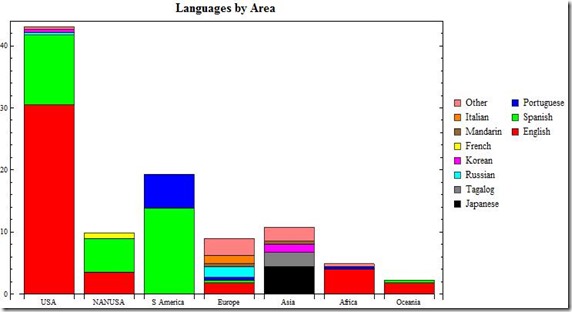
13 May Languages by AreaThe Church trains missionaries in about fifty languages.  My sample size is now 223 and includes twenty three languages.  The sample is about twice as large as my original sample but still relies too heavily on calls received in May 2013.  The primary problem with May data is that it has an unusually large number of calls to missions operating in the United States, 52% of all calls compared to a three month moving average of 37%.  This skews the data to overestimate the number of missionaries serving in the United States and speaking English.  Even with the weaknesses of the sample, interesting results emerge. 

The three most common languages spoken by missionaries are the languages of European colonizers, English, Spanish and Portuguese and the calls are issued in much greater numbers to their former colonies than to the colonizing nations.  Forty-two percent of calls were to speak English and only 2% of those calls were to England.  English is the most common language of calls issued to missionaries assigned to Africa and Oceania.  Spanish is the second most common language, used by 38% of all missionaries.  A modest .4% of calls to preach the gospel in Spanish are issued to missionaries assigned to Spain.  Portuguese repeats the pattern.  Six percent of all calls were issued in Portuguese, 5% in South America, .4% in Africa, and only .4% in Portugal. 

The most commonly spoken languages native to the countries where the missionaries are assigned are Japanese (4.5%), Tagalog (2.2%), Russian (1.8%), English (1.8%) and Korean (1.3%). 

The language assignments also show some modern migratory patterns: Spanish in the United States, Canada and Australia and Mandarin in the United Kingdom.  There is no evidence of the Church following the migration of Muslims to Europe or the United States by examining language assignments.

In future posts, I will compare languages assigned to Elders and Sisters and breakout languages in the seven areas listed above by country.