Thursday, June 6, 2013

May Update on Mission Assignments by Language

Doctrine and Covenants 90:11.  For it shall come to pass in that day, that every man shall hear the fulness of the gospel in his own tongue, and in his own language, through those who are ordained unto this power, by the administration of the Comforter, shed forth upon them for the revelation of Jesus Christ.
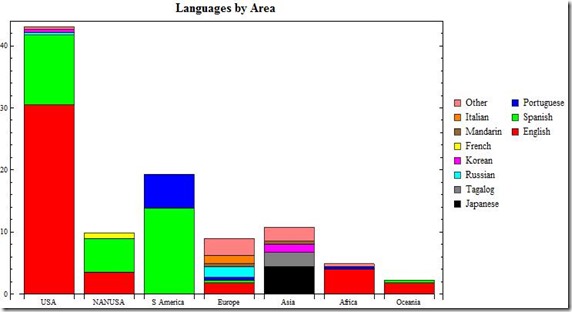
13 May Languages by AreaThe Church trains missionaries in about fifty languages.  My sample size is now 223 and includes twenty three languages.  The sample is about twice as large as my original sample but still relies too heavily on calls received in May 2013.  The primary problem with May data is that it has an unusually large number of calls to missions operating in the United States, 52% of all calls compared to a three month moving average of 37%.  This skews the data to overestimate the number of missionaries serving in the United States and speaking English.  Even with the weaknesses of the sample, interesting results emerge. 

The three most common languages spoken by missionaries are the languages of European colonizers, English, Spanish and Portuguese and the calls are issued in much greater numbers to their former colonies than to the colonizing nations.  Forty-two percent of calls were to speak English and only 2% of those calls were to England.  English is the most common language of calls issued to missionaries assigned to Africa and Oceania.  Spanish is the second most common language, used by 38% of all missionaries.  A modest .4% of calls to preach the gospel in Spanish are issued to missionaries assigned to Spain.  Portuguese repeats the pattern.  Six percent of all calls were issued in Portuguese, 5% in South America, .4% in Africa, and only .4% in Portugal. 

The most commonly spoken languages native to the countries where the missionaries are assigned are Japanese (4.5%), Tagalog (2.2%), Russian (1.8%), English (1.8%) and Korean (1.3%). 

The language assignments also show some modern migratory patterns: Spanish in the United States, Canada and Australia and Mandarin in the United Kingdom.  There is no evidence of the Church following the migration of Muslims to Europe or the United States by examining language assignments.

In future posts, I will compare languages assigned to Elders and Sisters and breakout languages in the seven areas listed above by country. 

Sunday, June 2, 2013

May 2013 Update on Mission Calls Posted to YouTube

YouTube Callings Sisters vs Elcer

The surge in missionary applications is continuing.  The graph, “Mission Calls Posted to YouTube,” separates the calls to young women and men from November 2011 to May 2013.  In May, the total number of posted calls reached 202; the greatest number of postings at the end of a month to date.  For the second straight month, the number of postings by young men relative to young women decreased slightly.  Last month 61.3% of posted calls were to young men and 38.7, to young women.  In May, 58.4% of posted calls were to young men and 41.6%, to young women.  The number of postings appears to have plateaued at around 200 per month suggesting that the surge too has plateaued. 

Wednesday, May 29, 2013

Growth of the Church in Brazil

Brazil Growth Comparisons

The seeds from which the Church of Jesus Christ of Latter-day Saints in Brazil grew sprouted in Germany, not Brazil and the first missionaries arrived from Salt Lake City via Buenos Aires to teach a minority immigrant group in a language foreign to Brazil.  The German migration to Argentina and Brazil following WWI included LDS families.  In 1923 Wilhelm Friedrich and Emile Hoppe arrived in Buenos Aires and as members began preaching the gospel.  They reported their success and concerns to the First Presidency by letter and asked for missionaries because brother Friedrich, the only Priesthood holder, was a Deacon and did not have the authority to baptize his daughter or the investigators they had found.  (Historical information from “Unto Every Nation: Gospel Light Reaches Every Land “ by Cannon and Cowan.)

Thursday, May 23, 2013

Languages Spoken by Missionaries

Languages by area

I have added a new variable to my YouTube data, language.  It is an interest part of the mission call and as I have listened to many videos I have come to realize that the Church’s effort to reach minority communities is vast and extends beyond the United States.  I have found that the YouTube data to be fairly reliable but it does have a weakness.  Nearly all posting are by young men and women whose native language is English.   

The graph “Languages by Area” shows the percentage of calls in seven major languages by the areas used by the Church to report demographic statistics with one exception.  I separate data for the United States from the rest of North America.  I have 103 observations, mostly from May and more assignments have been issued to missions in the United States (52%) than in previous three months (34%).  As an aside, the same pattern existed last year. 

Wednesday, May 22, 2013

An Evangelical View of the LDS Missionary Surge

Matthew 7: 20 Wherefore by their fruits ye shall know them.

21 Not every one that saith unto me, Lord, Lord, shall enter into the kingdom of heaven; but he that doeth the will of my Father which is in heaven.

Latter-day Saints and Evangelicals are brothers and sisters in the Christian faith.  There are differences in our theologies that are real.  We call these differences additional light and truth; Evangelicals call them misinterpretations of the gospel.  Let us not exaggerate the differences.  I believe that individuals would be happier, families stronger and the nation more prosperous if all professing to be followers of Christ followed with more faith.

In a mostly flattering article (“What Can Christians Learn From the Surge in Mormon Youth Missionaries?”) written in three parts by Greg Stier, John Divito and Kara Powell about Latter-day Saint youth and their response to President Monson’s announcement lowering that age of missionary service.  The article note the high level of commitment of LDS youth compared to Evangelical youth.  Greg Stier writes

Thursday, May 16, 2013

The Wait to Enter the Mission Training Center

Does the length of time between the date a missionary receives a call and the report date to the MTC vary by the country assigned?  Yes! 

Because all missionaries must buy roughly the same clothing, know the same scriptures, etc., the difference in the preparation period is probably due to the length of time needed to acquire a visa. My data source is YouTube posts made in 2013 of future missionaries opening their calls.  There were 707 posts.  The three countries with the longest preparation period are Brazil (133 days), New Zealand (131 days) and Australia (128 days), and the shortest period, the Philippines, (82 days), the USA (85 days), and South Korea (94 days). 

The preparation time for missionaries assigned to the United States acts like a control.  Because most YouTube videos are posted by missionaries living in the United States, and they will not require a visa to serve, missionaries assigned to the United States should have a short preparation period and it does.  Only missionaries assigned to the Philippines have a shorter wait. 

The following table contains the shows the number of countries to which at least ten missionaries were called, the number of calls to that country and the preparation period.


Country

Number of Observations

Days of Preparation

Argentina

24

106

Australia

21

128

Brazil

49

133

Canada

14

99

Chile

2

113

France

10

115

Japan

24

113

Mexico

19

115

New Zealand

12

131

Peru

15

123

Philippines

23

82

Russia

11

110

South Korea

10

94

Spain

10

121

United Kingdom

36

117

United States

270

85

Monday, May 13, 2013

April Update on Missionary Calls Posted to YouTube

2013 April YouTube Callings

This post updates findings on missionary calls using YouTube videos to track changes in the size and composition of the missionary force as our youth respond to President Monson’s October 2012 announcement that the Church was changing the age requirements for missionary service. The graph, “Mission Calls Posted to YouTube,” separates the calls to young women and men from November 2011 to April 2013.  In April, the total number of posted calls reached 199; 61.3% of posted calls were to young men and 38.7, to young women.  The number of calls to both groups initially climbed and appears to have plateaued.